|
of the seismic data, (ii) the availability
of sufficient capital resources by the Company and the other participants
for the drilling of the prospects (not all of which resources
are currently available), (iii) the approval of the prospects
by other participants after additional data has been compiled,
(iv) the economic and industry conditions at the time of drilling,
including prevailing and anticipated prices for oil and natural
gas and the availability of drilling rigs and crews, (v) the financial
resources and results of the Company and its partners and (vi)
the availability of leases on reasonable terms and permitting
for the prospect. There can be no assurance that these projects
can be successfully developed or that any identified drillsites
or budgeted wells discussed will, if drilled, encounter reservoirs
of commercially productive oil or natural gas. The Company may
seek to sell or reduce all or a portion of its interest in a project
area or with respect to prospects or wells within a project area.
The success of the Company
will be materially dependent upon the success of its exploratory
drilling program. Exploratory drilling involves numerous risks,
including the risk that no commercially productive oil or natural
gas reservoirs will be encountered. The cost of drilling, completing
and operating wells is often uncertain, and drilling operations
may be curtailed, delayed or canceled as a result of a variety
of factors, including unexpected drilling conditions, pressure
or irregularities in formations, equipment failures or accidents,
adverse weather conditions, compliance with governmental requirements
and shortages or delays in the availability of drilling rights
and the delivery of equipment. Although the Company believes that
its use of 3-D seismic data and other advanced technologies should
increase the probability of success of its exploratory wells and
should reduce average finding costs through elimination of prospects
that might otherwise be drilled solely on the basis 2-D seismic
data, exploratory drilling remains a speculative activity. Even
when fully utilized and properly interpreted, 3-D seismic data
and other advanced technologies only assist geoscientists in identifying
subsurface structures and do not enable the interpreter to know
whether hydrocarbons are in fact present in such structures. In
addition, the use of 3-D seismic data and other advanced technologies
requires greater predrilling expenditures than traditional drilling
strategies and the Company could incur losses as a result of such
expenditures. The Company's future drilling 7 activities may not
be successful, and if unsuccessful, such failure will have a material
adverse effect on the Company's results of operations and financial
condition. There can be no assurance the Company's overall drilling
success rate or its drilling success rate for activity within
a particular project area will not decline. The Company may choose
not to acquire option and lease rights prior to acquiring seismic
data and, in many cases, the Company may identify a prospect or
drilling location before seeking option or lease rights in the
prospect or location. Although the Company has identified or budgeted
for numerous drilling prospects, there can be no assurance that
such prospects will ever be leased or drilled (or drilled within
the scheduled or budgeted time frame) or that oil or natural gas
will be produced from any such prospects or any other prospects.
In addition, prospects may initially be identified through a number
of methods, some of which do not include interpretation of 3-D
or other seismic data. Wells that are currently in the Company's
capital budget may be based upon statistical results of drilling
activities in other 3-D project areas that the Company believes
are geologically similar, rather than on analysis of seismic or
other data. Actual drilling and results are likely to vary from
such statistical results and such variance may be material. Similarly,
the Company's drilling schedule may vary from its capital budget
because of future uncertainties, including those described above.
The description of a well as "budgeted" does not mean that the
Company currently has or will have the capital resources to drill
the well. See "Management's Discussion and Analysis of Financial
Condition and Results of Operations."
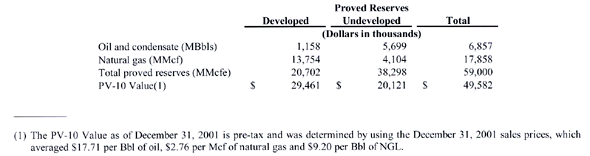
Oil and Natural Gas Reserves
The following table sets
forth estimated net proved oil and natural gas reserves of the
Company and the PV-10 Value of such reserves as of December 31,
2001. The reserve data and the present value as of December 31,
2001 were prepared by Ryder Scott Company and Fairchild & Wells,
Inc., Independent Petroleum Engineers. For further information
concerning Ryder Scott's and Fairchild's estimate of the proved
reserves of the Company at December 31, 2001, see the reserve
reports included as exhibits to this Annual Report on Form 10-K.
The PV-10 Value was prepared using constant prices as of the calculation
date, discounted at 10% per annum on a pretax basis, and is not
intended to represent the current market value of the estimated
oil and natural gas reserves owned by the Company. For further
information concerning the present value of future net revenue
from these proved reserves, see Note 12 of Notes to Financial
Statements.
|