|
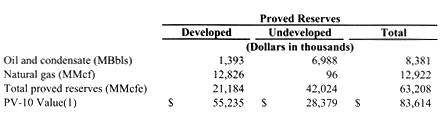
prepared by Ryder Scott Company and Fairchild
& Wells, Inc., Independent Petroleum Engineers. For further information
concerning Ryder Scott's and Fairchild's estimate of the proved
reserves of the Company at December 31, 2002, see the reserve reports
included as exhibits to this Annual Report on Form 10-K. The PV-10
Value was prepared using constant prices as of the calculation date,
discounted at 10% per annum on a pretax basis, and is not intended
to represent the current market value of the estimated oil and natural
gas reserves owned by the Company. For further information concerning
the present value of future net revenue from these proved reserves,
see Note 13 of Notes to Consolidated Financial Statements.
(1) The PV-10 Value as of December
31, 2002 is pre-tax and was determined by using the December 31,
2002 sales prices, which averaged
$29.16 per Bbl of oil, $4.70 per Mcf of natural gas.
No estimates of proved reserves
comparable to those included herein have been included in reports
to any federal agency other than the Securities and Exchange Commission
(the "Commission").
There are numerous uncertainties
inherent in estimating oil and natural gas reserves and their estimated
values, including many factors beyond the control of the producer.
The reserve data set forth in this Annual Report on Form 10-K represent
only estimates. Reservoir engineering is a subjective process of
estimating underground accumulations of oil and natural gas that
cannot be measured in an exact manner. Estimates of economically
recoverable oil and natural gas reserves and of future net cash
flows necessarily depend upon a number of variable factors and assumptions,
such as historical production from the area compared with production
from other producing areas, the assumed effects of regulations by
governmental agencies and assumptions concerning future oil and
natural gas prices, future operating costs, severance and excise
taxes, development costs and workover and remedial costs, all of
which may in fact vary considerably from actual results. For these
reasons, estimates of the economically recoverable quantities of
oil and natural gas attributable to any particular group of properties,
classifications of such reserves based on risk of recovery, and
estimates of the future net cash flows expected therefrom prepared
by different engineers or by the same engineers but at different
times may vary substantially and such reserve estimates may be subject
to downward or upward adjustment based upon such factors. Actual
production, revenues and expenditures with respect to the Company's
reserves will likely vary from estimates, and such variances may
be material. In addition, the 10% discount factor, which is required
by the Commission to be used in calculating discounted future net
cash flows for reporting purposes, is not necessarily the most appropriate
discount factor based on interest rates in effect from time to time
and risks associated with the Company or the oil and natural gas
industry in general.
In general, the volume of production
from oil and natural gas properties declines as reserves are depleted,
with the rate of decline depending on reservoir characteristics.
Except to the extent the Company conducts successful exploration
and development activities or acquires properties containing proved
reserves, or both, the proved reserves of the Company will decline
as reserves are produced. The Company's future oil and natural gas
production is, therefore, highly dependent upon its level of success
in finding or acquiring additional reserves. The business of exploring
for, developing or acquiring reserves is capital intensive. To the
extent cash flow from operations is reduced and external sources
of capital become limited or unavailable, the Company's ability
to make the necessary capital investment to maintain or expand its
asset base of oil and natural gas reserves would be impaired. The
failure of an operator of the Company's wells to adequately perform
operations, or such operator's breach of the applicable agreements,
could adversely impact the Company. In addition, there can be no
assurance that the Company's future exploration, development and
acquisition activities will result in additional proved reserves
or that the Company will be able to drill productive wells at acceptable
costs. Furthermore, although the Company's revenues could increase
if prevailing prices for oil and natural gas increase significantly,
the Company's finding and development costs could also increase.
See "Management's Discussion and Analysis of Financial Condition
and Results of Operations".
10
|