|
Once incurred, a write-down of oil and natural
gas properties is not reversible at a later date. Based on oil and
gas prices in effect on December 31, 2001, the unamortized cost
of our oil and gas properties exceeded the cost center ceiling.
In accordance with full cost accounting rules, improvements in pricing
subsequent to December 31, 2001, removed the necessity to record
a write-down. Using prices in effect on December 31, 2001 the write-down
would have been approximately $0.7 million.
The Company typically uses fixed rate swaps
and costless collars to hedge its exposure to material changes in
the price of natural gas and oil. The Company formally documents
all relationships between hedging instruments and hedged items,
as well as its risk management objectives and strategy for undertaking
various hedge transactions. This process includes linking all derivatives
that are designated cash flow hedges to forecasted transactions.
The Company also formally assesses, both at the hedge's inception
and on an ongoing basis, whether the derivatives that are used in
hedging transactions are highly effective in offsetting changes
in cash flows of hedged transactions.
The Company's Board of Directors sets
all of the Company's hedging policy, including volumes, types of
instruments and counterparties, on a quarterly basis. These policies
are implemented by management through the execution of trades by
either the President or Chief Financial Officer after consultation
and concurrence by the President, Chief Financial Officer and Chairman
of the Board. The master contracts with the authorized counterparties
identify the President and Chief Financial Officer as the only Company
representatives authorized to execute trades. The Board of Directors
also reviews the status and results of hedging activities quarterly.
In November 2001, the Company had no-cost
collars with an affiliate of Enron Corp., designated as hedges,
covering 2,553,000 MMBtu of gas production from December 2001 through
December 2002. The value of these derivatives at that time was $0.8
million. Because of Enron's financial condition, the Company concluded
that the derivatives contracts were no longer effective and thus
did not qualify for hedge accounting treatment. As required by SFAS
No. 133, the value of these derivative instruments as of November
2001 $(0.8 million) was recorded in accumulated other comprehensive
income and will be reclassified into earnings over the original
term of the derivative instruments. An allowance for the related
asset totaling $0.8 million, net of tax of $0.4 million, was charged
to other expense. At December 31, 2001 and 2002, $0.7 million and
none, net of tax of $0.4 million and none, respectively, remained
in accumulated other comprehensive income related to the deferred
gains on these derivatives.
Total oil purchased and sold under hedging
arrangements during 2000, 2001 and 2002 were 87,900 Bbls, 18,000
Bbls and 131,300 Bbls, respectively. Total natural gas purchased
and sold under hedging arrangements in 2000, 2001 and 2002 were
1,590,000 MMBtu and 3,087,000 MMBtu and 2,314,000 MMBtu, respectively.
The net gains and (losses) realized by the Company under such hedging
arrangements were $(1.5 million), $2.0 million and $(0.9 million)
for 2000, 2001 and 2002, respectively, and are included in oil and
gas revenues.
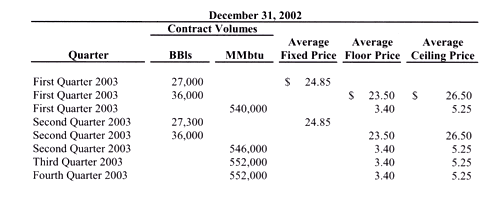
At December 31, 2001 the Company had no derivative
instruments outstanding designated as hedge positions. At December
31, 2002 the Company had the following outstanding hedge positions:
ITEM 7A. QUALITATIVE AND QUANTITATIVE DISCLOSURE
ABOUT MARKET RISK
COMMODITY RISK. The Company's major
market risk exposure is the commodity pricing applicable to its
oil and natural gas production. Realized commodity prices received
for such production are primarily driven by the prevailing worldwide
price for oil and spot prices applicable to natural gas. The effects
of such pricing volatility have been discussed above, and such volatility
is expected to continue. A 10% fluctuation in the price received
for oil and gas production would have an approximate $2.6 million
impact on the Company's annual revenues and operating income.
36
|

