|
Inherent in
the fair value calculation of ARO are numerous assumptions and judgments
including the ultimate settlement amounts, inflation factors, credit
adjusted discount rates, timing of settlement, and changes in the
legal, regulatory, environmental and political environments. To
the extent future revisions to these assumptions impact the fair
value of the existing ARO liability, a corresponding adjustment
is made to the oil and natural gas property balance. Settlements
greater than or less than amounts accrued as ARO are recovered as
a gain or loss upon settlement.
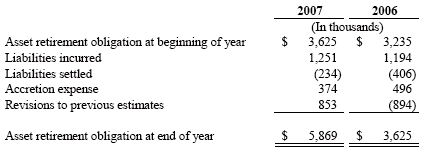
The following
table is a reconciliation of the asset retirement obligation liability
for the years ended December 31:
Foreign Currency
The company has foreign activities related
to its operations in the U.K. North Sea. Accordingly, assets and
liabilities relatedto these operations are translated into United
States dollars at exchange rates in effect at the balance sheet
date. Income andexpense items are translated at average exchange
rates throughout the year. Translation adjustments are charged or
credited toother comprehensive income (loss) and are recorded net
of applicable taxes. Transaction gains or losses that occur due
to the realization of assets and the settlement of liabilities using
a currency denominated in other than the functional currency are
charged to earnings.
Recently Issued Accounting Pronouncements
In September 2006, the FASB issued SFAS
No. 157, “Fair Value Measurements” (“SFAS
No. 157”). SFAS No. 157 defines fair value, establishes a framework
for measuring fair value under Generally Accepted Accounting Principles
and requires enhanced disclosures about fair value measurements.
It does not require any new fair value measurements. SFAS No. 157
is effective for financial statements issued for fiscal years beginning
after November 15, 2007 and interim periods within those fiscalyears.
The Company does not expect a material impact from SFAS No. 157
on its consolidated financial statements.
In February 2007, the FASB issued SFAS No.
159, “The Fair Value Option for Financial Assets and Financial
Liabilities”(“SFAS No. 159”), which permits entities
to choose to measure many financial instruments and certain other
items at fair value.The objective is to improve financial reporting
by providing entities with the opportunity to mitigate volatility
in reported earningscaused by measuring related assets and liabilities
differently without having to apply complex hedge accounting provisions.
SFAS No. 159 applies to all entities and is effective for fiscal
years beginning after November 15, 2007. The Company does notexpect
a material impact from SFAS No. 159 on its consolidated financial
statements.
In December 2007, the FASB issued SFAS No.
141 (revised 2007), “Business Combinations” (“SFAS
No. 141(R)”). SFAS No. 141(R) establishes principles and requirements
to recognize the assets acquired and liabilities assumed in an acquisition
transaction and determines what information to disclose to investors
regarding the business combination. SFAS No. 141(R) is effective
for business combinations for which the acquisition date is on or
after the beginning of the first annual period beginning after December
15, 2008.
In December 2007, the FASB issued SFAS No.
160, “Noncontrolling Interests in Consolidated Financial
Statements – an amendment of ARB No. 51” (“SFAS
No. 160”). SFAS No. 160 establishes accounting and reporting
standards with respect to the disclosure of a noncontrolling ownership
interest in the statement of financial position within equity, the
presentation of the share of consolidated net income attributable
to the parent and noncontrolling interest on the consolidated statement
of income, the accounting treatment of changes in a parent’s
ownership interest while the parent retains a controlling interest
and the accountingfor the deconsolidation of a subsidiary. SFAS
No. 160 is effective for fiscal years, and interim periods within
those fiscal years,beginning on or after December 15, 2008. The
Company currently has no noncontrolling ownership interests in consolidated
subsidiaries and does not expect a material impact from SFAS No.
160 on its consolidated financial statements.
Recently Adopted Accounting Pronouncements
We adopted the Financial Accounting Standards
Board's Interpretation No. 48, “Accounting for Uncertainty
in Income Taxes, an Interpretation of FASB Statement No. 109”
(“FIN 48”), effective January 1, 2007. FIN 48 clarifies
the accounting for uncertainty in income taxes recognized in financial
statements and requires the impact of a tax position to be recognized
in the
|