| |
Revenue Recognition and Natural Gas Imbalances
The Company follows the sales method of
accounting for revenue recognition and natural gas imbalances, which
recognizes over and under lifts of natural gas when sold, to the
extent sufficient natural gas reserves or balancing agreements are
in place.Natural gas, natural gas liquids and oil sales volumes
are not significantly different from the Company’s share of
production.
Financing Costs, net
Net long-term debt financing costs of $5.9
million (net of $4.0 million accumulated amortization) and $4.8
million (net of $1.8million accumulated amortization) were capitalized
and included in other assets as of December 31, 2007 and 2006, respectively,and
are being amortized using the effective yield method over the term
of the loans through July 2010 for the Second Lien CreditFacility
and through May 2010 for the Senior Secured Revolving Credit Facility.
Supplemental Cash Flow Information
The Statement of Cash Flows for the year
ended December 31, 2007 does not include the adjustment of the investment
in Pinnacle of $5.4 million, net of tax. The Statement of Cash Flows
for the year ended December 31, 2006 does not include the acquisition
of $55,000 of oil and gas properties in exchange for the Company’s
common stock and the capitalization of stock-based compensation
associated with the adoption of SFAS 123(R) of $1.7 million, net
of tax. The Statement of Cash Flows for the year ended December
31, 2005 does not include interest paid-in-kind of $1.3 million,
the net exercise of 80,000 warrants forcommon stock and the acquisition
of $2.0 million of oil and gas properties in exchange for the Company’s
common stock.
Financial Instruments
The Company's financial instruments consist
of cash, receivables, payables and long-term debt. The carrying
amount of cash, receivables and payables approximates fair value
because of the short-term nature of these items. The carrying amounts
of long-term debt approximate fair value as these borrowings bear
interest at variable interest rates.
Stock-Based Compensation
In June of 1997, the Company established
the Incentive Plan of Carrizo Oil & Gas, Inc. (the “Incentive
Plan”), which authorizes the granting of stock options and
stock awards to directors, employees and independent contractors.
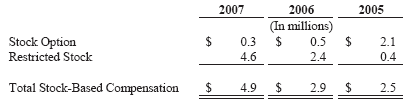
The Company recognized the following stock-based compensation expenses
for the years ended December 31:
Stock Options Prior to January
1, 2006, the Company accounted for stock-based compensation utilizing
the intrinsic value method as permitted under Accounting Principles
Board (“APB”) Opinion No. 25, “Accounting for
Stock Issued to Employees.” APB Opinion No. 25 recognized
compensation expense only when the market price on the grant date
exceeded the option exercise price. In February 2000, the Company
repriced certain employee and director stock options and accounted
for these repriced stock options in accordance with Financial Accounting
Standards Board (“FASB”) Interpretation No. 44 “Accounting
for Certain Transactions involving Stock-Based Compensation –
An Interpretation of APB No. 25,” (“FIN 44”)
which prescribes the variable plan accounting treatment for repriced
stock options. Under variable plan accounting, compensation expense
is adjusted for increases or decreases in the fair market value
of the Company’s common stock to the extent that the market
value exceeds the exercise price of the option until the options
are exercised, forfeited, or expire unexercised. Under these accounting
guidelines,the Company recognized $2.1 million of stock-based compensation
expense for the year ended December 31, 2005.
Effective January 1, 2006, the Company adopted
Statement of Financial Accounting Standards (“SFAS”) No.
123 (revised 2004), “Share-Based Payment” (“SFAS
No. 123(R)”), which requires companies to measure all stock-based
compensation awards using the fair value method and record such
expense in the financial statements over the vesting period of the
options, which is generally three years. The Company implemented
SFAS No. 123(R) using the modified prospective transition method.
The Company recognizes compensation expense
for all unvested options outstanding as of January 1, 2006, options
issued after January 1, 2006, and those options that are subsequently
modified, repurchased or cancelled. The compensation expense isbased
on the grant-date fair value of the options and expensed over the
vesting period. The Company did not restate prior periods to reflect
the impact of adopting the new standard. As part of the adoption
of SFAS No. 123(R), the Company stopped recording stock-based compensation
expense associated with the February 2000 repriced options mentioned
above and the liability
|
|